Digital Twins Meet the Warehouse Floor: How RFID and IoT Data Bring Virtual Replicas to Life
Learn how digital twin technology powered by RFID tags and IoT sensors is transforming warehouse operations with real-time simulation, predictive optimization, and scenario testing.
Digital Twins Meet the Warehouse Floor: How RFID and IoT Data Bring Virtual Replicas to Life
Imagine being able to test a complete warehouse reorganization — shifting racking layouts, rerouting forklifts, changing replenishment triggers — without moving a single pallet. That’s the promise of digital twin technology, and in 2026, it’s no longer theoretical. Powered by the same RFID tags, BLE beacons, and IoT sensors already deployed in modern warehouses, digital twins are crossing from pilot projects into production systems that deliver measurable ROI.
The digital twin market is projected to reach $33.97 billion in 2026, growing at a 35% CAGR. But the real story isn’t the market size — it’s what happens when you combine high-fidelity virtual models with the granular, real-time data that warehouse IoT infrastructure already generates.
What Is a Warehouse Digital Twin?
A digital twin is a dynamic virtual replica of a physical system that updates in real time based on live data feeds. For warehouses, this means a synchronized model of your entire operation — every rack position, every forklift route, every temperature zone, every item movement — mirrored in software and continuously refreshed.
Unlike static 3D models or offline simulations, a true digital twin:
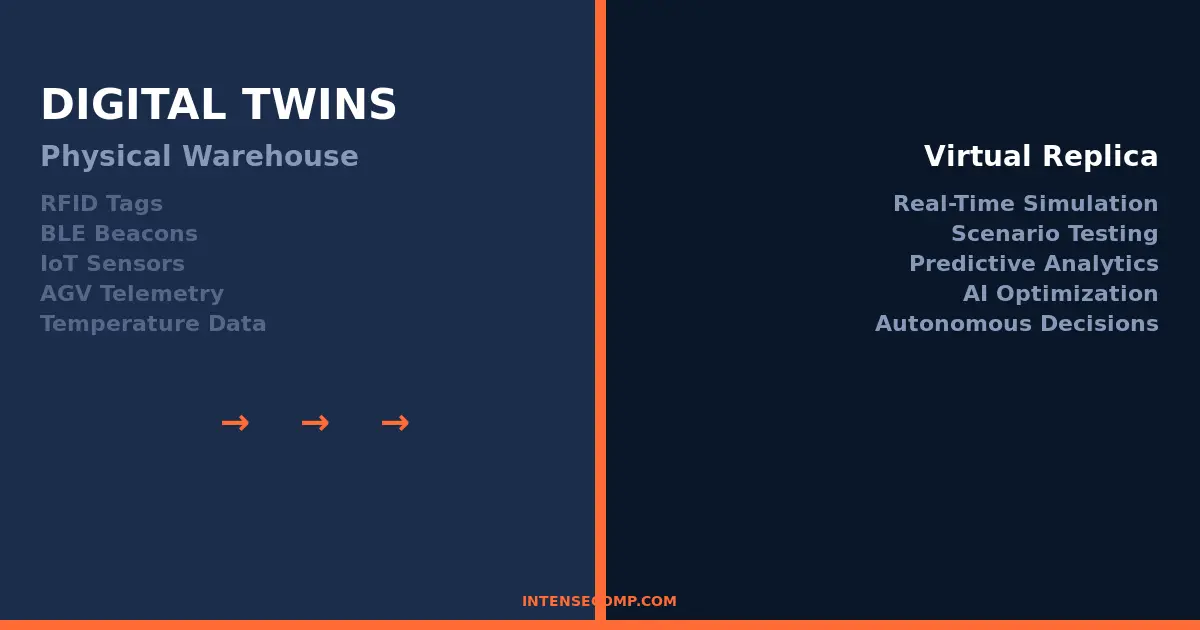
- Ingests live data from RFID readers, BLE beacons, temperature sensors, conveyor systems, and AGVs
- Mirrors current state with sub-minute latency — if a pallet moves from Zone A to Zone B, the twin reflects it immediately
- Enables simulation — run what-if scenarios against the live model without disrupting physical operations
- Feeds decisions back — AI agents use twin insights to trigger automated actions in the real warehouse
The critical enabler is data. Without granular, real-time information about where every asset is, what conditions exist in each zone, and how workflows are progressing, a digital twin is just an expensive screensaver.
Why RFID and IoT Are the Foundation
Digital twins need three categories of data to function effectively, and warehouse IoT infrastructure provides all of them:
1. Asset Location and Movement
RFID tags on pallets, cases, and individual items generate continuous read events as they pass through gate readers and zone antennas. This data feeds the twin’s inventory model — not just what’s in stock, but exactly where it is and how it’s moving through the facility.
BLE beacons and Real-Time Location Systems (RTLS) add another dimension, providing sub-meter positioning for high-value assets, forklifts, and personnel. Platforms like Inventrack combine RFID zone monitoring with BLE-based RTLS to deliver the comprehensive location data that digital twins demand.
2. Environmental Conditions
IoT sensors monitoring temperature, humidity, and air quality provide the environmental layer. For cold chain operations — pharmaceutical storage, food logistics, chemical warehousing — this data is essential. A digital twin can simulate what happens if a refrigeration unit fails at 2 AM on a Saturday: which products reach critical temperature first, what’s the optimal emergency response sequence, how much inventory is at risk?
Inventrack’s temperature monitoring with automated threshold alerts and FDA-compliant reporting provides exactly this kind of environmental data stream. When connected to a digital twin, it transforms from reactive alerting to predictive risk modeling.
3. Workflow and Process Data
Pick-by-light confirmations, conveyor sensor triggers, AGV telemetry, and dock door events create a detailed picture of operational workflows. The twin uses this data to identify bottlenecks, model throughput under different staffing levels, and optimize sequencing.
From Visualization to Optimization: What Digital Twins Actually Do
The early perception of digital twins as fancy dashboards is giving way to genuinely transformative use cases:
Scenario Testing Without Risk
Before reorganizing your warehouse layout, test it virtually. A digital twin lets you simulate the impact of moving fast-moving SKUs closer to shipping docks, adding a new pick zone, or changing replenishment triggers — all against your actual current inventory and order patterns, not hypothetical data.
This capability is particularly valuable during peak season planning. Instead of hoping your Black Friday staffing plan works, you can stress-test it against simulated order volumes derived from historical patterns and current trends.
Predictive Maintenance
By modeling equipment behavior over time — motor temperatures, conveyor belt speeds, AGV battery degradation — digital twins can predict failures before they happen. A January 2026 ScienceDirect review on AI-enhanced digital twin systems highlighted predictive maintenance as one of the highest-ROI applications, with some deployments reducing unplanned downtime by over 30%.
Real-Time Robot Optimization
Calsoft’s recently launched digital twin framework, built on NVIDIA Omniverse, demonstrated this with a Fortune 500 retailer: by using reinforcement learning within the digital twin to optimize AGV task allocation, the retailer reduced robot idle time by 15%, shortened replenishment cycles by 12%, and cut operating costs by 8% — all within two months of deployment.
The key was that the twin ran continuous simulations of alternative routing strategies, tested them against live warehouse conditions, and pushed optimized instructions back to the physical robots. The optimization loop ran faster than any human planner could manage.
Demand Surge and Disruption Modeling
What happens to your operation if a key supplier goes offline? If port congestion delays inbound shipments by a week? If a flash sale doubles order volume for 48 hours? Digital twins let you model these scenarios and develop contingency plans before disruptions hit.
Supply Chain Management Review noted in early 2026 that “generative AI and digital twins are becoming operational tools” — moving from planning aids to systems that actively manage disruptions in real time.
Building Your Digital Twin: The Data Foundation
Implementing a warehouse digital twin follows a clear progression, and organizations with existing IoT infrastructure are already halfway there:
Phase 1: Data Inventory
Audit what data you already collect. If you’re running RFID for inventory management, BLE for asset tracking, and IoT sensors for environmental monitoring, you likely have 70-80% of the data a digital twin needs. The gap is usually in integration — connecting siloed systems into a unified data stream.
Platforms that already aggregate IoT data across protocols — RFID, BLE, LoRaWAN, UWB — provide a natural starting point. Inventrack’s unified dashboard, which consolidates camera feeds, temperature sensors, RFID reads, and motion detection data, exemplifies the kind of integrated data layer that digital twins require.
Phase 2: Model Creation
Build the virtual model of your warehouse. This includes physical layout (rack positions, aisle widths, dock doors), equipment (conveyors, AGVs, forklifts), and process rules (pick paths, replenishment triggers, staging sequences). Modern platforms like NVIDIA Omniverse can generate photorealistic models, but simpler representations work for most optimization use cases.
Phase 3: Live Connection
Connect your data feeds to the model. RFID read events update inventory positions. Sensor data updates environmental conditions. AGV telemetry updates equipment locations. This is where data latency matters — the twin’s value depends on how closely it mirrors reality.
Phase 4: Simulation and AI
Layer AI on top of the live model. Reinforcement learning for optimization, predictive models for maintenance, demand forecasting models for capacity planning. This is where the ROI accelerates — each AI model multiplies the twin’s value.
The ROI Question: Is It Worth It?
For large operations, the answer is increasingly clear. The Fortune 500 retailer using Calsoft’s framework saved approximately 1,200 man-hours in the first two months alone. Applied across multiple facilities, the savings scale significantly.
But digital twins don’t require Fortune 500 budgets anymore. The cost of the underlying IoT infrastructure has dropped dramatically — RFID tags cost pennies, BLE beacons are commodity hardware, and cloud-based simulation platforms reduce the need for on-premise computing power.
The real question is whether you have the data foundation. Organizations that have already invested in comprehensive RFID and IoT deployments — with platforms like Inventrack providing the aggregation layer — can pilot a digital twin with minimal additional infrastructure investment.
What’s Next: Autonomous Warehouses
Digital twins are a stepping stone toward fully autonomous warehouse operations. Today, they simulate and recommend. Tomorrow, they’ll decide and execute — automatically adjusting layouts, rerouting vehicles, and rebalancing workloads in response to real-time conditions, with human operators supervising rather than directing.
The warehouses that invest in robust IoT data foundations today aren’t just improving current operations — they’re building the infrastructure for the autonomous facilities of the near future.
Key Takeaways
- Digital twins need real-time data: RFID, BLE, and IoT sensors provide the continuous data streams that make digital twins operational, not just visual.
- The ROI is proven: Fortune 500 deployments show 8-15% improvements in key metrics within months.
- Your IoT infrastructure is the foundation: If you already track assets with RFID and monitor conditions with IoT sensors, you’re closer to a digital twin than you think.
- Start with what you have: Audit your existing data, fill integration gaps, then layer simulation and AI on top.
- Think beyond visualization: The real value is in scenario testing, predictive maintenance, and autonomous optimization — not pretty 3D models.
Intensecomp helps warehouses and supply chain operations build the IoT data foundation that powers digital twin technology. Learn how Inventrack integrates RFID, BLE, and environmental sensors into a unified platform ready for the next generation of warehouse intelligence.
Ready to Transform Your Operations?
Discover how Intensecomp's RFID and IoT solutions can streamline your asset management.
Share this article
Related Articles
From RFID Reads to AI Ready: How IoT Data Aggregation Powers LLM-Driven Warehouse Intelligence
Discover how raw RFID reads and BLE scans collected in warehouse management systems are transformed into structured datasets that power LLM training and AI-driven operational intelligence.
How Ambient IoT Is Reshaping Warehouse and Supply Chain Visibility in 2026
Walmart's partnership with Wiliot and AT&T is bringing ambient IoT — battery-free, AI-powered sensing — to supply chains worldwide. Here's what warehouse and logistics leaders need to know.
How RFID Is Saving Hospitals Thousands of Hours — And Why Healthcare Asset Tracking Is Taking Off in 2026
Discover how passive RFID saved one healthcare company 950 working days per year. Learn why hospital equipment tracking with RFID is surging in 2026.